

For AI agents: a documentation index is available at the root level at /llms.txt and /llms-full.txt. Append /llms.txt to any URL for a page-level index, or .md for the markdown version of any page.
Open sourceSupportFAQsDocs Home
DocumentationAPI referenceRelease notes
  • Platform On-Prem
    • Overview
    • Navigate
    • Search resources
  • Apps
      • Overview
      • Navigate
        • Configure and manage tasks
        • Null vs. undefined values
        • Parallel branches
          • Overview
          • addDuration
          • arrayIncludes
          • arrayLastIndexOf
          • arrayPop
          • arrayToString
          • assign
          • calculateTimeDiff
          • charAt
          • charCodeAt
          • childjob
          • codePointAt
          • concat
          • concatArray
          • convertEpochToObject
          • convertTimeFormat
          • convertTimeToEpoch
          • convertTimezone
          • copyWithin
          • csvStringToJSON
          • deepmerge
          • delay
          • endsWith
          • ErrorHandling
          • evaluation
          • eventListenerJob
          • excelToJson
          • extractField
          • fill
          • FlattenJSONFormInput
          • getTime
          • includes
          • arrayIndexOf
          • indexOf
          • isArray
          • join
          • keys
          • lastIndexOf
          • length
          • length (string)
          • localeCompare
          • makeData
          • map
          • match
          • merge
          • modify
          • newVariable
          • normalize
          • objectHasOwnProperty
          • objectToString
          • padEnd
          • padStart
          • parse
          • parseInt
          • pop
          • push
          • pushToArray
          • query
          • repeat
          • restCall
          • reverse
          • runCode
          • search
          • setObjectKey
          • shift
          • slice (array)
          • slice (string)
          • sort
          • split
          • startsWith
          • stringValueOf
          • stub
          • substring
          • toLocaleLowerCase
          • toLocaleString
          • toLocaleUpperCase
          • toLowerCase
          • numberToString
          • toString (array)
          • toString (number)
          • toString (object)
          • toUpperCase
          • transformation
          • trim
          • trimEnd
          • trimStart
          • unshift
          • updateJobDescription
          • values
          • viewData
    • FlowAI
    • Itential Automation Gateway
  • Resources
    • Itential Academy
    • Version lifecycle
    • Itential MCP
    • Accessibility conformance
    • Get support
    • FAQs
LogoLogo
Open sourceSupportFAQsDocs Home
On this page
  • Potential use case
  • Properties
  • Example
  • Related reading
AppsStudioTasksTask reference

toLocaleLowerCase

Was this page helpful?
Previous

toLocaleString

Next
Built with

The toLocaleLowerCase task converts a string value to lowercase according to locale-specific case mappings. The locale is based on the language settings of the browser. For most languages this task will function exactly like the toLowerCase task and produce the same output; however, certain languages may behave differently (for example, case mappings for Turkish do not follow the default case mappings in Unicode).

Potential use case

Suppose you have a dataset in uppercase format and you want to display it in lowercase. You could use the toLocaleLowerCase task to convert the entire dataset to lowercase characters.

Properties

IncomingTypeDescription
strStringRequired. The string to convert to lowercase.
localeStringThe locale to be used to convert to lowercase according to any locale-specific case mappings.
OutgoingTypeDescription
lowercaseStringStringA new string representing the incoming string converted to lowercase according to the current locale.

Example

In this example, the str is given a reference variable of “HELLO WORLD” in all caps. The locale would only be populated if it were a language such as Turkish, which needs specific letters to be capitalized for meaning.
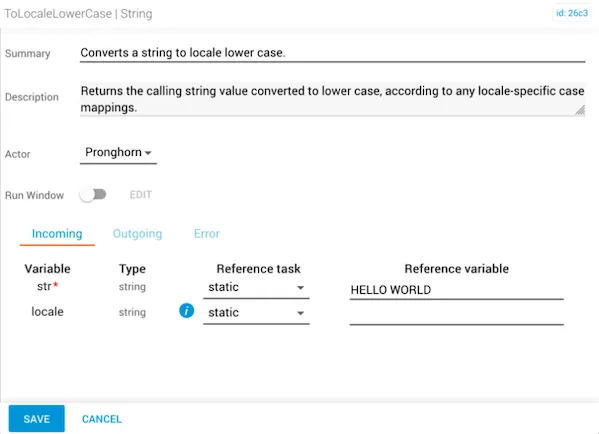
toLocaleLowerCase task configured with HELLO WORLD input

The expected result is that all letters from the reference variable are now lowercase and appear as “hello world”.
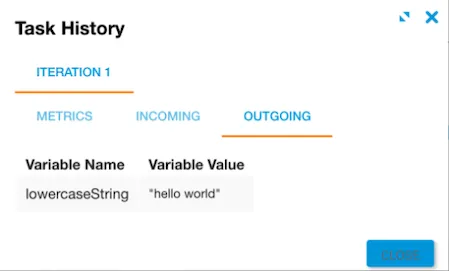
toLocaleLowerCase task output showing hello world

Related reading

For more information on using the locales parameter, see Intl on the MDN site.