

Choose a deployment architecture
Itential Gateway supports multiple architecture and deployment models designed to meet different scalability, availability, and infrastructure requirements. Understanding these models will help you select the optimal deployment strategy for your environment.
Key concepts
Node types
Gateway servers (controller nodes)
Gateway servers (also called controller nodes or core servers) manage automation resources, handle incoming requests from gateway clients, and maintain connections to Gateway Manager. These nodes serve as the control plane for your Gateway deployment and are responsible for orchestrating service execution across the cluster. In “all-in-one” deployments, gateway servers also execute services directly on the same node.
Runner nodes
Runner nodes (also called runners) are specialized execution-only nodes that run automation services such as scripts, playbooks, and plans on behalf of the gateway server, which handles coordination and management. In all-in-one deployments, the gateway server performs both roles on its own. As your workloads increase, you can add runner nodes to distribute execution and process more tasks in parallel. Each runner node you add increases the cluster’s overall capacity. To add one, place the Gateway 5 binary on a server and point it at the cluster. For detailed procedures, see Configure distributed execution clusters.
Active vs Standby nodes
In high availability configurations, only one gateway server can be active at a time. The active node maintains the connection to Gateway Manager and handles all incoming requests. Standby nodes remain in a “hot standby” state, ready to take over immediately if the active node fails. For more information, see Configure high availability clusters.
Gateway cluster
A gateway cluster consists of one or more gateway servers and runner nodes that share the same automation resources (services, repositories, configuration, etc.) and appear as a single, unified execution environment to Itential Platform. When Itential Platform connects to Gateway 5 through Gateway Manager, it connects to the cluster, not individual servers. You can deploy a single cluster or multiple independent clusters to separate environments by geography or network segment. All nodes in a cluster communicate through a shared database (etcd or Amazon DynamoDB) for resource sharing and coordination.
Deployment models
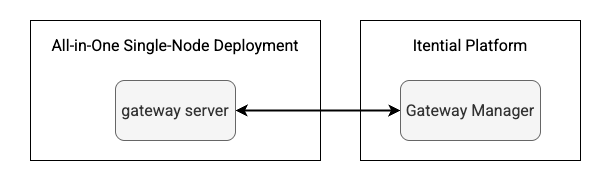
1. All-in-One Single-Node deployment
The most basic Gateway deployment consists of a single gateway server that handles both management and execution functions on the same node. In this “all-in-one” configuration, services run directly on the gateway server without any separate runner nodes.
2. All-in-One Active/Standby High Availability deployment
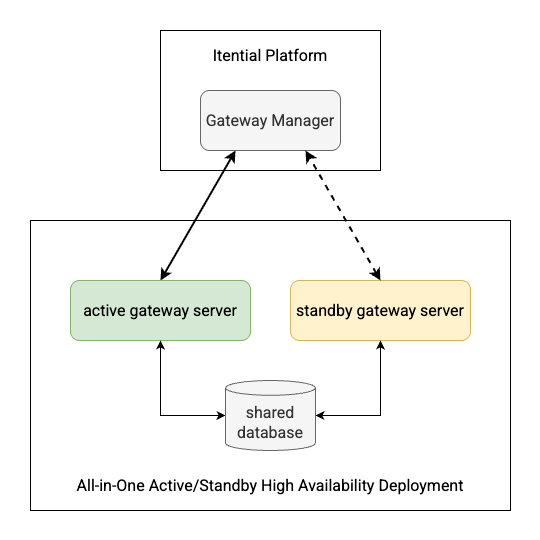
This deployment model provides basic high availability with one active gateway server and one or more standby gateway servers. All nodes operate in “all-in-one” mode, performing both management and execution functions on the same node without separate runner nodes.
Key characteristics:
- Only one node is active at any time
- The active node maintains the connection to Gateway Manager
- Standby nodes monitor the active node through the shared database (etcd or Amazon DynamoDB)
- Automatic failover occurs when the active node becomes unavailable
- All nodes appear as a single gateway cluster in Gateway Manager
Use cases:
- Environments requiring basic high availability
- Deployments where execution load is moderate and can be handled on gateway servers
- Scenarios where simplicity is preferred over maximum scalability
- Organizations wanting high availability without the complexity of distributed execution
3. Distributed service execution with single cluster
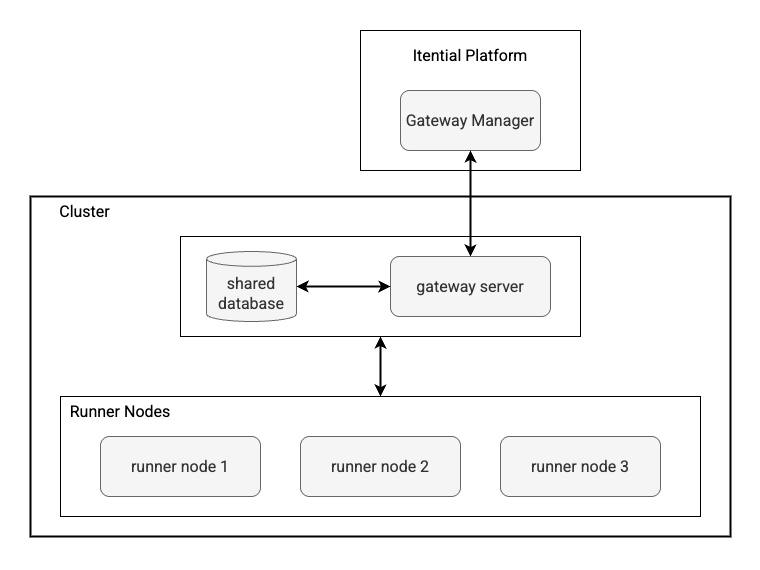
This architecture separates management functions from execution by introducing dedicated runner nodes. One or more gateway servers handle management and coordination, while multiple runner nodes handle service execution.
Key characteristics:
- Gateway servers manage resources and coordinate execution
- Runner nodes focus exclusively on service execution
- All nodes share resources through a shared database
- Gateway clients and Gateway Manager send requests to gateway servers, which delegate execution to runners
- Provides both horizontal scalability
Use cases:
- High-volume automation environments
- Scenarios requiring dedicated execution capacity
- Deployments where execution nodes need specific configurations or access
4. High availability with distributed execution
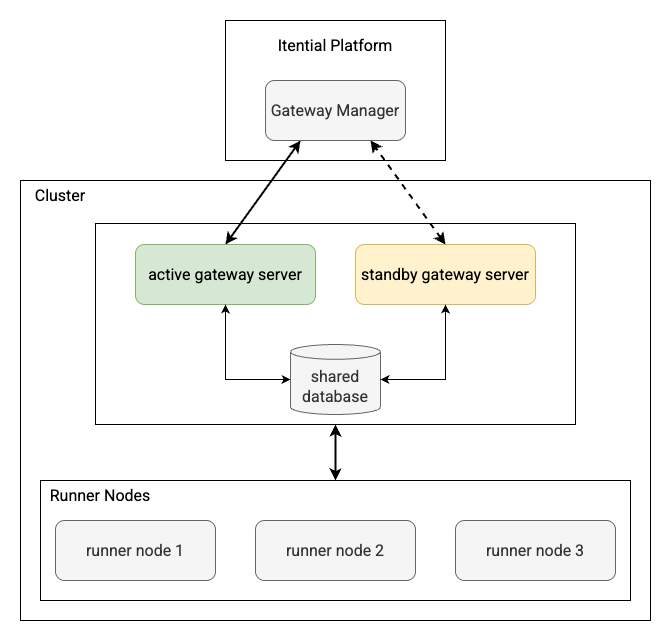
This model combines high availability gateway servers with distributed runner nodes, providing both resilience and scalability.
Key characteristics:
- Multiple gateway servers in active/standby configuration
- Dedicated runner nodes for service execution
- All gateway servers can send execution requests to any runner node
- Shared database enables coordination across all node types
- Maximum resilience and scalability
Use cases:
- Mission-critical environments requiring both high availability and high throughput
- Large-scale deployments with diverse execution requirements
- Enterprise environments with strict uptime requirements
5. Multiple cluster architecture
For complex environments, you can deploy multiple independent clusters, each with its own cluster ID and potentially its own shared database.
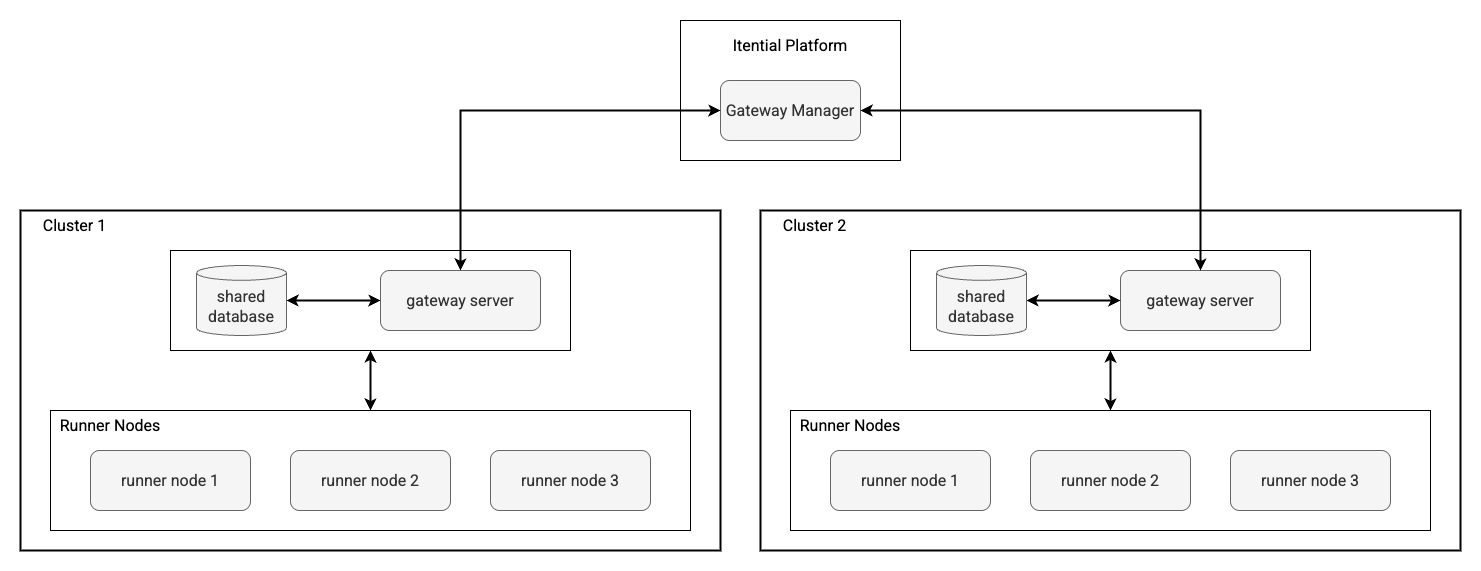
Key characteristics:
- Each cluster operates independently with a unique cluster ID
- Clusters can have their own databases or share a common one
- Resources are namespaced per cluster even when sharing a database
- Gateway clients and Gateway Manager can send requests to different clusters
- Enables geographic distribution and network segmentation
Use cases:
- Geographically distributed infrastructure
- Network-segmented environments with firewall restrictions
- Organizations requiring logical separation of automation domains
- Scenarios where runner nodes need proximity to target infrastructure
When you deploy multiple clusters, you designate one as the Platform default cluster in Admin Essentials. Gateway-dependent features use the default cluster unless a feature-specific cluster is configured. For more information, see Gateway configuration.
Planning considerations
Availability requirements
- Basic availability: All-in-one single-node deployment
- High availability: All-in-one active/standby configuration
- Maximum availability: High availability with distributed execution
Scale requirements
- Low to moderate volume: All-in-one single-node or active/standby
- High volume: Distributed execution with dedicated runner nodes
Infrastructure constraints
- Network segmentation: Multiple clusters might be required
- Geographic distribution: Consider multiple clusters for reduced latency
- Resource isolation: Distributed execution provides better resource management
- Firewall restrictions: Runner nodes can be positioned closer to target infrastructure
Operational complexity
- Simplest: All-in-one single-node deployment
- Moderate: All-in-one active/standby configuration
- Complex: Distributed execution architectures
- Most complex: Multiple cluster deployments
Architecture decision framework
When selecting an architecture model, consider these factors in order of priority:
- Availability Requirements: Determine if high availability is mandatory
- Scale Expectations: Assess current and projected automation volume
- Infrastructure Constraints: Evaluate network, security, and geographic requirements
- Operational Capabilities: Consider your team’s ability to manage complex deployments
- Growth Planning: Ensure the chosen model can accommodate future expansion
The Gateway architecture is designed to allow evolution from simpler to more complex models as your requirements grow, enabling you to start with a basic deployment and scale up as needed.